Outsytems | Figma | Jira

OFSD Individual Performance
An internal platform for continuous performance and feedback, designed for employees in industrial and remote environments, such as oil platforms. The product transforms real work moments—project deliveries, handovers, and operational events—into structured, contextualized evaluations, replacing traditional one-off feedback models.
The solution provides employees with a clear view of their performance over time, while enabling managers and HR teams to analyze trends by region, team, and business area. Built to support distributed operations in complex contexts, the system promotes transparency, continuous development, and data-driven decision-making.
G
The Goal
An internal platform enabling continuous, contextualized evaluation and monitoring of employee performance, aligned with real operational conditions. The solution supports both individual employee development and informed decision-making by managers and HR teams.
P
The Problem
Traditional performance appraisal models were sporadic, infrequent, and disconnected from actual fieldwork. In industrial and operational environments—where teams rotate frequently, projects are temporary, and work occurs at critical moments—this approach often led to delayed, unhelpful, and sometimes incomplete or unfair feedback.
I
Initial Approach
We analyzed the company’s operational context, focusing on key daily work moments such as project deliveries, handovers, sprint reviews, and internal events. The product was then designed as an event-driven system, where feedback is not an isolated process but seamlessly integrated into existing workflows.
S
The Solution
A platform for continuous performance and feedback, based on evaluations triggered by real events. The system allows employees to track their individual performance over time, while offering a comprehensive and comparable view for management teams. Through configurable triggers, feedback becomes consistent, timely, and fair.
Macro Flow (end-to-end)
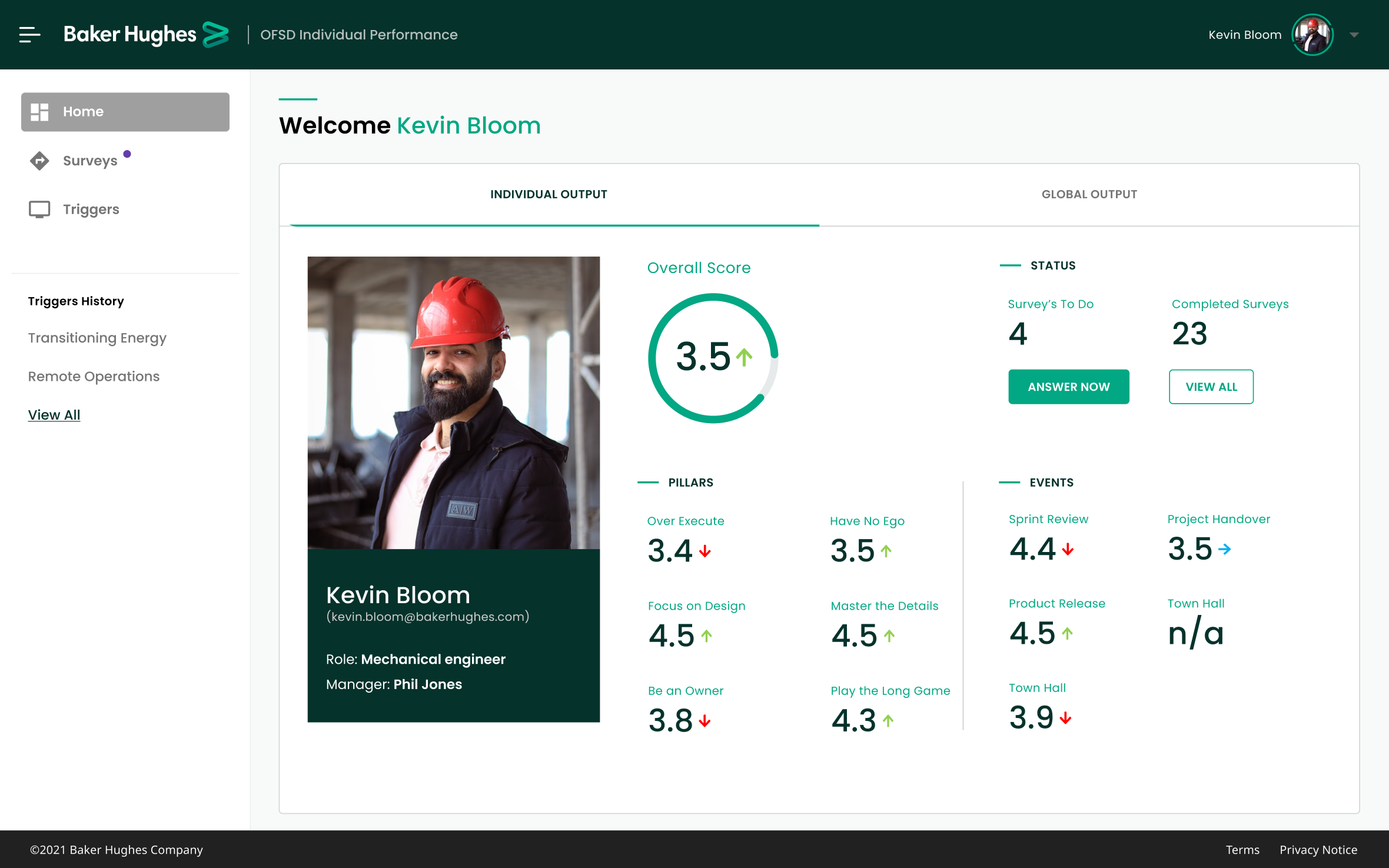
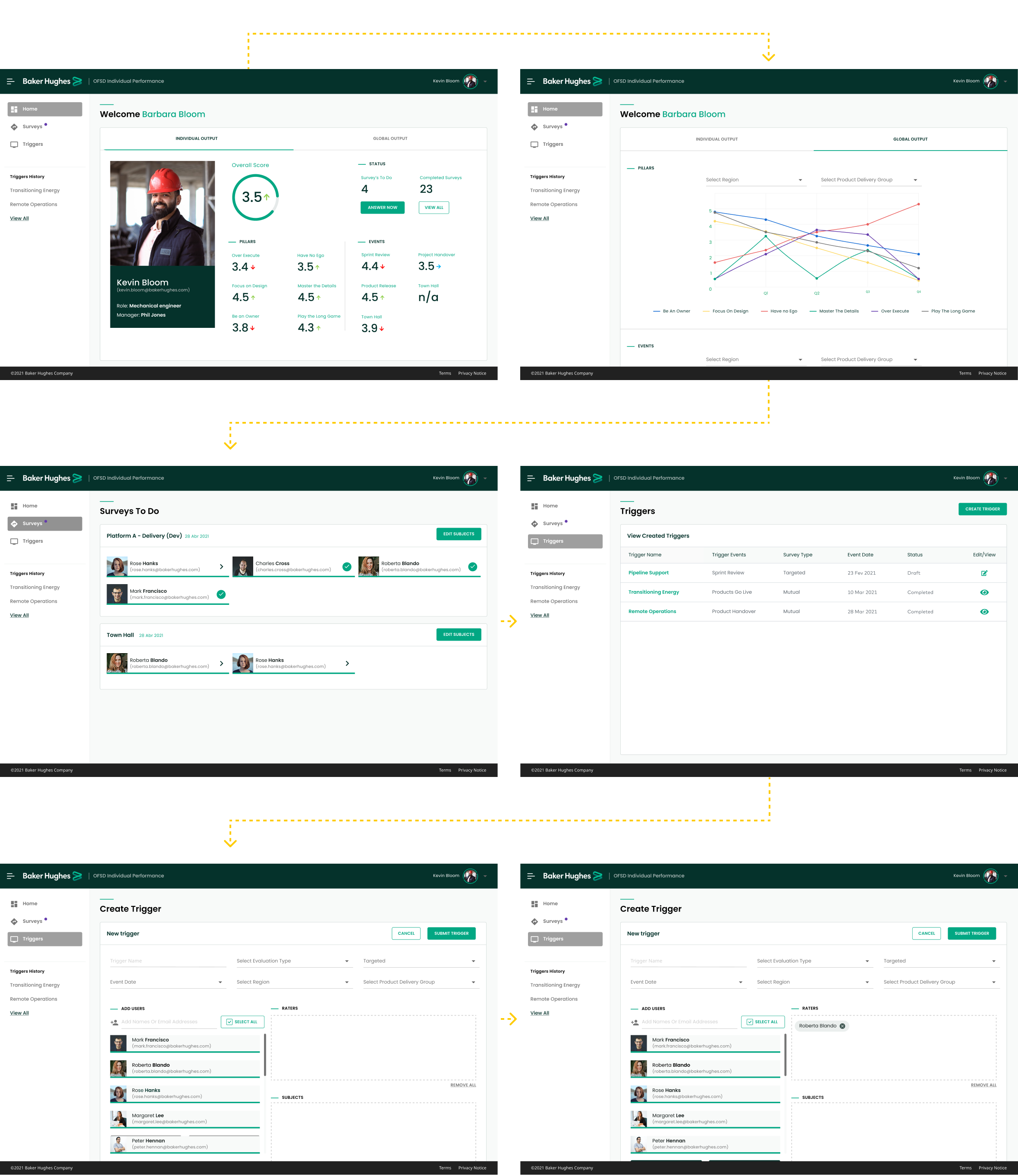
The workflow starts with employees accessing the platform and viewing their performance on a dashboard that aggregates feedback from multiple work moments. This view allows them to track scores, monitor progress over time, and see results tied to specific events, providing a clear, contextualized understanding of their performance.
The system also provides a global perspective, aggregating data by teams, regions, or business areas, helping align individual performance with organizational trends. Employees receive surveys linked to specific projects or events, ensuring feedback is timely and relevant to actual work.
For management, the workflow includes a back office where managers and HR configure evaluation triggers based on operational events. These triggers automatically initiate feedback cycles, closing the loop between configuration, data collection, and visualization, and supporting a continuous, integrated performance model in daily operations.
UI Decisions
UX/UI decisions focused on minimizing cognitive load in demanding work environments with limited time. The interface features a clear visual hierarchy, making key metrics and progress immediately visible, so users can quickly understand their performance without deep exploration.
Consistent visuals across individual dashboards, global views, and survey flows reinforce predictability and ease of use. Meanwhile, the modular content organization simplifies navigation between analysis, actions, and configuration, even in a system with high functional complexity.
Impact
From a UX perspective, the impact is seen in increased clarity, trust, and engagement with the feedback process. By presenting information in an accessible, contextualized way, the platform reduces friction, encourages survey participation, and fosters a more transparent relationship between employees and the organization.
Feedback stops feeling like an administrative task and becomes seamlessly integrated into users’ daily work.

Outsytems | Figma | Jira
OFSD Individual Performance
An internal platform for continuous performance and feedback, designed for employees in industrial and remote environments, such as oil platforms. The product transforms real work moments—project deliveries, handovers, and operational events—into structured, contextualized evaluations, replacing traditional one-off feedback models.
The solution provides employees with a clear view of their performance over time, while enabling managers and HR teams to analyze trends by region, team, and business area. Built to support distributed operations in complex contexts, the system promotes transparency, continuous development, and data-driven decision-making.
G
The Goal
An internal platform enabling continuous, contextualized evaluation and monitoring of employee performance, aligned with real operational conditions. The solution supports both individual employee development and informed decision-making by managers and HR teams.
P
The Problem
Traditional performance appraisal models were sporadic, infrequent, and disconnected from actual fieldwork. In industrial and operational environments—where teams rotate frequently, projects are temporary, and work occurs at critical moments—this approach often led to delayed, unhelpful, and sometimes incomplete or unfair feedback.
I
Initial Approach
We analyzed the company’s operational context, focusing on key daily work moments such as project deliveries, handovers, sprint reviews, and internal events. The product was then designed as an event-driven system, where feedback is not an isolated process but seamlessly integrated into existing workflows.
S
The Solution
A platform for continuous performance and feedback, based on evaluations triggered by real events. The system allows employees to track their individual performance over time, while offering a comprehensive and comparable view for management teams. Through configurable triggers, feedback becomes consistent, timely, and fair.
Macro Flow (end-to-end)
The workflow starts with employees accessing the platform and viewing their performance on a dashboard that aggregates feedback from multiple work moments. This view allows them to track scores, monitor progress over time, and see results tied to specific events, providing a clear, contextualized understanding of their performance.
The system also provides a global perspective, aggregating data by teams, regions, or business areas, helping align individual performance with organizational trends. Employees receive surveys linked to specific projects or events, ensuring feedback is timely and relevant to actual work.
For management, the workflow includes a back office where managers and HR configure evaluation triggers based on operational events. These triggers automatically initiate feedback cycles, closing the loop between configuration, data collection, and visualization, and supporting a continuous, integrated performance model in daily operations.
UI Decisions
UX/UI decisions focused on minimizing cognitive load in demanding work environments with limited time. The interface features a clear visual hierarchy, making key metrics and progress immediately visible, so users can quickly understand their performance without deep exploration.
Consistent visuals across individual dashboards, global views, and survey flows reinforce predictability and ease of use. Meanwhile, the modular content organization simplifies navigation between analysis, actions, and configuration, even in a system with high functional complexity.
Impact
From a UX perspective, the impact is seen in increased clarity, trust, and engagement with the feedback process. By presenting information in an accessible, contextualized way, the platform reduces friction, encourages survey participation, and fosters a more transparent relationship between employees and the organization.
Feedback stops feeling like an administrative task and becomes seamlessly integrated into users’ daily work.

Outsytems | Figma | Jira
OFSD Individual Performance
An internal platform for continuous performance and feedback, designed for employees in industrial and remote environments, such as oil platforms. The product transforms real work moments—project deliveries, handovers, and operational events—into structured, contextualized evaluations, replacing traditional one-off feedback models.
The solution provides employees with a clear view of their performance over time, while enabling managers and HR teams to analyze trends by region, team, and business area. Built to support distributed operations in complex contexts, the system promotes transparency, continuous development, and data-driven decision-making.
G
The Goal
An internal platform enabling continuous, contextualized evaluation and monitoring of employee performance, aligned with real operational conditions. The solution supports both individual employee development and informed decision-making by managers and HR teams.
P
The Problem
Traditional performance appraisal models were sporadic, infrequent, and disconnected from actual fieldwork. In industrial and operational environments—where teams rotate frequently, projects are temporary, and work occurs at critical moments—this approach often led to delayed, unhelpful, and sometimes incomplete or unfair feedback.
I
Initial Approach
We analyzed the company’s operational context, focusing on key daily work moments such as project deliveries, handovers, sprint reviews, and internal events. The product was then designed as an event-driven system, where feedback is not an isolated process but seamlessly integrated into existing workflows.
S
The Solution
A platform for continuous performance and feedback, driven by real work events. The system enables employees to track their performance over time while giving management teams a comprehensive, comparable view. Configurable triggers ensure that feedback is consistent, timely, and fair.
Macro Flow (end-to-end)
The workflow starts with employees accessing the platform and viewing their performance on a dashboard that aggregates feedback from multiple work moments. This view allows them to track scores, monitor progress over time, and see results tied to specific events, providing a clear, contextualized understanding of their performance.
The system also provides a global perspective, aggregating data by teams, regions, or business areas, helping align individual performance with organizational trends. Employees receive surveys linked to specific projects or events, ensuring feedback is timely and relevant to actual work.
For management, the workflow includes a back office where managers and HR configure evaluation triggers based on operational events. These triggers automatically initiate feedback cycles, closing the loop between configuration, data collection, and visualization, and supporting a continuous, integrated performance model in daily operations.
UI Decisions
UX/UI decisions focused on minimizing cognitive load in demanding work environments with limited time. The interface features a clear visual hierarchy, making key metrics and progress immediately visible, so users can quickly understand their performance without deep exploration.
Consistent visuals across individual dashboards, global views, and survey flows reinforce predictability and ease of use. Meanwhile, the modular content organization simplifies navigation between analysis, actions, and configuration, even in a system with high functional complexity.
Impact
From a UX perspective, the impact is seen in increased clarity, trust, and engagement with the feedback process. By presenting information in an accessible, contextualized way, the platform reduces friction, encourages survey participation, and fosters a more transparent relationship between employees and the organization.
Feedback stops feeling like an administrative task and becomes seamlessly integrated into users’ daily work.